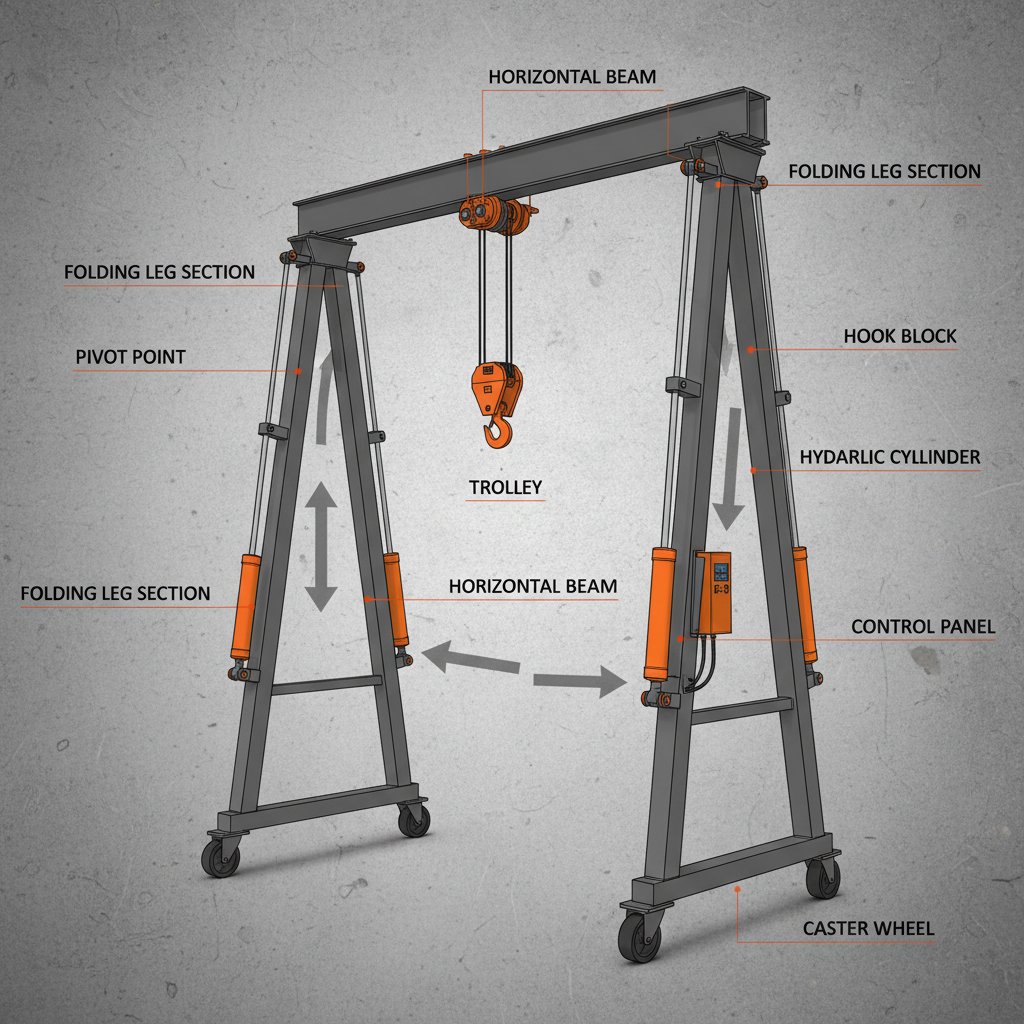
Look, I’ve been running around construction sites for fifteen years, dealing with all kinds of lifting equipment. And let me tell you, things are changing fast. Everyone’s talking about modular construction, prefabrication… it all means we need more flexible lifting solutions. That’s where adjustable height gantry cranes come in. It's not just about lifting heavy stuff anymore; it's about adapting to ever-changing project needs. Honestly, it’s a bit of a headache sometimes, keeping up with all the new demands.
But to be honest, the biggest issue I see is people trying to over-engineer things. They get caught up in fancy software and simulations, forgetting that this stuff is going to be used by real people in the mud and the rain. I encountered this at a power plant in Jiangsu province last time. They had this incredibly complex gantry system, all bells and whistles, but the guys on the ground couldn’t figure out how to adjust the height quickly. A simple, robust design is almost always better. It really is.
These days, a lot of the gantries use high-strength steel, naturally. It smells like… well, steel, you know? That slightly oily, metallic tang. And it's heavy. You can tell a good piece of steel by the way it feels in your hand, the weight, the solidity. But the newer ones are starting to incorporate aluminum alloys too, especially for lighter duty applications. It makes a huge difference when you’re trying to move things around on a crowded site. Strangel,y though, the aluminum ones always seem to get scratched up faster.
The Changing Landscape of Adjustable Height Gantry Cranes
You see, it's not just construction anymore. Ports, warehouses, even some of the big data centers are using these things. They need to be able to lift and move equipment quickly and safely, and an adjustable height gantry crane just gives them that flexibility. The demand for faster turnaround times is driving a lot of the innovation.
And with the rise of prefabrication, you need gantries that can adapt to different sized modules. One day you’re lifting a small bathroom pod, the next you’re handling a whole section of wall. It’s a constant juggling act, and that's where the adjustability really shines.
Design Pitfalls and Practical Considerations
Have you noticed how many gantries are designed by engineers who’ve never actually used one? They'll specify some complicated locking mechanism that takes ten minutes to operate. Or they'll make the base too narrow, so it's unstable on uneven ground. It drives me crazy! I’ve seen guys shim up the legs with wood blocks just to get it level. Honestly, it’s embarrassing.
The biggest mistake is forgetting about maintenance. Everything needs to be greased and inspected regularly, especially the lifting points. And you need to think about accessibility. Can a mechanic easily get under the gantry to do repairs? If not, you’re going to have downtime, and downtime costs money.
Another thing, don’t underestimate the importance of wind resistance. A fully loaded gantry can act like a sail in a strong wind. You need to make sure it’s properly anchored or equipped with a wind speed monitoring system. Anyway, I think a lot of the smaller companies overlook that one.
Material Science and On-Site Handling
Like I said, steel is the workhorse. But the quality of the steel varies. You want something with good weldability and ductility. The smell of a bad weld is something you never forget. It’s acrid and…wrong. It’s a smell that sends shivers down my spine. I swear.
The newer high-strength steels require specialized welding techniques, which a lot of smaller fabrication shops don’t have. That’s why you sometimes see cracks and failures. And don’t even get me started on the Chinese steel that’s been flooding the market lately… some of it's just not up to standard, you know? It feels flimsy, doesn’t have the weight.
When handling the components, especially the larger ones, you need to use proper lifting slings and shackles. And for goodness sake, don’t let anyone stand under a load! I’ve seen too many close calls. Later... Forget it, I won’t mention it.
Real-World Testing and Application Scenarios
Forget the lab tests, the real test is how it performs on a messy construction site. I like to see these things stress-tested with real loads, in real conditions. We once tested a gantry at a shipyard, lifting shipping containers in high winds. That told us a lot more than any computer simulation could have.
I’ve seen them used for everything from lifting precast concrete panels to installing HVAC equipment. They’re particularly useful in confined spaces where you can’t use a traditional crane. I remember one project where we had to lift a generator onto the roof of a building. No room for a crane, so an adjustable gantry was the only option.
Adjustable Height Gantry Crane Performance Metrics
Advantages, Disadvantages, and Customization Options
The biggest advantage, obviously, is the adjustability. But they’re also relatively easy to assemble and disassemble, which is a huge plus on a busy site. They are way more cost effective than a tower crane. However, they aren’t suitable for extremely heavy lifts, and they require a level surface to operate safely.
Customization is key. We recently had a customer who needed a gantry with a longer span to lift machinery over existing buildings. We designed a custom frame and reinforced the legs to handle the extra load. They also wanted a remote control system for the height adjustment. You can pretty much build anything if the budget allows.
A Customer Story: The Shenzhen Smart Home Boss
Last month, that small boss in Shenzhen who makes smart home devices insisted on changing the interface to – for some reason he thought it looked more “modern” – and the result was a week-long delay because all the existing slings and shackles were designed for the older style connectors. He ended up having to fly in a whole new set from Germany. It was a complete disaster. He learned a hard lesson that day: don’t fix what ain’t broken.
He needed a gantry to lift prototypes of his new smart fridge into the testing lab. The lab was in a tight spot, so we had to build a narrow-track gantry with a low headroom. He was a demanding customer, always changing his mind, but in the end, he was happy with the result. That’s what matters.
He told me, “This thing is a lifesaver! I can move those fridges around like they’re nothing.” That’s the kind of feedback that makes the job worthwhile.
Key Performance Indicators of Adjustable Height Gantry Cranes
So, when evaluating these things, what should you look at? It's not just about the price. You need to consider the lift capacity, the span, the height adjustment range, and the stability. And don't forget about safety features like overload protection and emergency stops.
Here’s a rough guide to what I look for, scribbled down in my notebook, basically:
These numbers are just examples, of course. It all depends on the specific application.
Key Performance Indicators for Adjustable Height Gantry Cranes
| KPI Category |
Measurement Unit |
Acceptable Range |
Importance Level (1-5) |
| Lift Capacity |
Tons |
1-20 |
5 |
| Span Length |
Meters |
5-30 |
4 |
| Height Adjustment Range |
Meters |
1-10 |
3 |
| Stability Rating |
Score (1-10) |
8-10 |
5 |
| Assembly Time |
Hours |
1-8 |
2 |
| Maintenance Frequency |
Months |
3-6 |
3 |
FAQS
It really depends on the model and the configuration. We have cranes that can lift from 1 ton to 20 tons, but it also depends on the span length. Longer spans mean lower lift capacity. You need to carefully consider your load requirements and choose a crane that’s appropriately sized. Overloading is a surefire way to have a bad day. We always recommend a safety factor of at least 1.25.
Yes, but you need to consider the weather conditions. We offer models with corrosion-resistant coatings for outdoor use, but they still need to be protected from extreme weather, like hurricanes or heavy snow. You also need to make sure the ground is level and stable. Wind is a big factor too, as I mentioned before. A crane acting like a sail isn’t a pretty sight.
Regular maintenance is crucial. You need to grease the moving parts, inspect the cables and shackles, and check the welds for cracks. We recommend a thorough inspection every 6 months, and more frequent inspections if the crane is used heavily. Ignoring maintenance will lead to breakdowns and safety hazards. Trust me, I’ve seen it happen.
Overload protection is a must-have. You also want emergency stops, limit switches to prevent over-travel, and a robust locking mechanism for the height adjustment. And always, always make sure the operator is properly trained. A well-trained operator is the best safety feature of all.
It depends on the model. Some of the smaller cranes can be assembled in a couple of hours with a basic toolkit. But the larger cranes require more specialized equipment and expertise. We offer on-site assembly services if you prefer. It’s worth the investment to ensure it’s done correctly.
Absolutely. We can customize everything from the span length and lift capacity to the height adjustment range and the control system. We’ve built cranes with special attachments for lifting specific types of materials, and we’ve even designed cranes with integrated platforms for workers. Just tell us your requirements, and we’ll do our best to make it happen.
Conclusion
So, there you have it. Adjustable height gantry cranes are becoming increasingly important in modern construction and manufacturing. They offer a flexible, cost-effective, and safe solution for a wide range of lifting applications. But it’s not just about the technology; it’s about understanding the practicalities of using these things on a real job site.
Ultimately, whether this thing works or not, the worker will know the moment he tightens the screw. Choose wisely, maintain it well, and always prioritize safety. And if you’re ever stuck, don’t hesitate to give us a call. We’re here to help. Visit our website: www.daweihoisting.com.